Building the winter shelter
Butcher's CrossingBuilding the winter shelter is the hunting party’s first sustained answer to the blizzard that traps it in Bison Valley. With the mountain pass blocked and no reliable prospect of escape, William Andrews, Miller, and Fred Schneider make a refuge from pine and Bison hides. Its construction is an act of practical survival: every available material is put to use, and the finished hut becomes the men’s home through the months of confinement. Yet the shelter’s hard-won security is limited. It can defend them from wind and snow, not preserve the expedition’s wagon, hides, and animals when the spring river later overwhelms them.
The decision to build
The need for shelter emerges from a worsening sequence of shortages and weather. Before the snowfall, the oxen’s restless movement around the wagon had already made the expedition’s small water supply a concern. Miller collected the water from the men’s canteens in a wooden keg; after the last drops had been drained, only about four inches remained. The snow then began to fall while the party was among the pines. William Andrews noticed the first flakes, but Miller and Schneider were already watching the darkening sky with alarm.
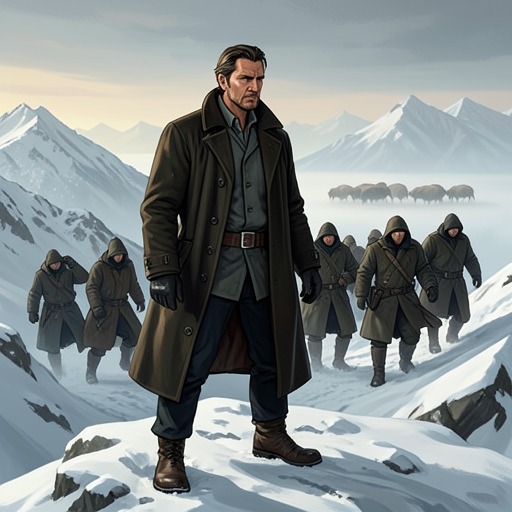
Miller rode toward the pass to assess the route and returned after nearly two hours, his horse exhausted and trembling. He reported that the party was blocked: he had turned back half a mile from the pass, where the snow lay about twelve feet deep, and it appeared worse farther on. Schneider had argued that they should leave earlier; now his anger at being ignored gave way to the immediate question of what could be done. Miller answered with a plan to build where they were. When Andrews wondered whether they would be safer in the open beneath the sun, Miller distinguished the comparative comfort of daytime from the danger of night: another storm, he reasoned, could destroy any refuge exposed out there. The trees would provide the setting for a shelter built to withstand weather rather than wait it out in the open.
Improvised materials and methods
The work occupied the rest of the day. William Andrews and Miller stripped small branches from pine stumps and stacked them near the fire; Schneider cut narrow, irregular thongs from a stiff, relatively small Bison hide. His knives caught in the hide’s hardness, forcing him to sharpen them repeatedly. For a means of softening the strips, he used a pot found among Charley Hoge’s tools under the snow. He filled it with ash gathered around the fire, added the hide thongs, and had the other men urinate into the mixture. Snow was added until the dark contents covered the strips, and the pot was set over the fire. The procedure is bluntly practical: the party has no purpose-made cordage for the job, so Schneider prepares what they can make from the materials and bodily resources at hand.
Meanwhile, the men shaped the shelter’s frame from the stripped pine trunks. They arranged four logs—two short and two long—into a rectangle in front of the fire. The ground was wet and obstructed by large tree roots and buried rocks, but they dug holes nearly two feet deep to set the logs firmly. Taller uprights stood at the front. They fitted long, thinner pine branches between the projecting ends, trimming them to meet more closely, until the framework formed a sturdy box-like structure. Its rear end stood about a foot high, while the front rose roughly to a man’s shoulders. The softened hide strips bound the branches together, though they remained stiff enough to bend only with difficulty.
Enclosing the refuge
By midafternoon the frame was complete, and the exhausted workers paused to eat the beans that had been cooking. All four men shared the same bowl, using whatever utensils they could find in the snow. The beans were unsalted and heavy in the stomach, but they finished the pot. When the three builders returned to the frame, the hide thongs had dried and contracted. They now held the logs together like iron straps, converting an improvised binding into a firm structural joint.
The rest of the construction turned that frame into an enclosure. Andrews, Miller, and Schneider covered it with Bison hides, fastening them to the logs with additional strips softened in the pot. They dug a shallow trench around the shelter and tucked the lower edges of the hides into it, covering them with turf and damp earth to keep air and moisture from entering. By nightfall, the hut had hide-lined walls, roof, and floor. The hides were packed tightly enough that the rear and sides were virtually proof against water and wind. Across the broad front, further hides hung loose to make an entrance; in windy conditions, they could be tied to stakes driven into the ground.
A home for the winter
The men recovered what remained of their sleeping bags from beneath the snow, divided the surviving blankets, and spread them by the fire to dry. In the last light of the day, William Andrews looked at the pine-and-hide structure and understood that it would be his home for the next six months, perhaps eight. The prospect unsettled him: he wondered what it would be like to live inside the shelter and feared that the days would become monotonous. That fear did not come to pass. Their time was occupied by work, and the shelter was the necessary center of a winter routine shaped by cold, snow, and the need to adapt.
The men made further equipment suited to their confinement. They cut narrow hide bands about two feet long, opened slits in them, and wore them over their eyes against the snow’s glare. They bent softened pine branches into oval frames and attached woven hide fringes to make crude snowshoes, allowing them to cross the thin, hard crust without sinking through. Softened skins became rough, sock-like boots tied around the calves, and additional hides were prepared as blankets and broad coats. These tasks extend the logic of the shelter: survival depended not on one finished building alone, but on continually reshaping the expedition’s remaining materials to meet the conditions outside it.
Significance and limits
The shelter marks a change from attempted passage to enforced habitation. The men had expected to travel onward; after Miller’s report from the pass, they instead commit a day’s labor to a structure meant to hold through a winter that might last six, seven, or eight months. Its design answers specific vulnerabilities: a roof and tightly packed hides against falling weather, buried edges against drafts and damp, and a closable entrance against the wind. The building is neither comfortable nor permanent in any grand sense, but it is a carefully made barrier between the men and the conditions that have trapped them.
That barrier also sharpens the contrast between survival and success. The shelter allows the party to live through confinement, while the expedition’s accumulated material gains remain exposed to a different natural hazard. When the men later attempt the spring crossing, a tree carried by the current strikes Fred Schneider’s horse; the horse falls on him, and the wagon is driven against the rocks. The load’s harness breaks, and the Bison hides are swept away with the current. The shelter therefore stands as a hard-earned, local solution rather than a reversal of the expedition’s larger fortunes: it protects life through the winter, but cannot keep the valley’s hazards from undoing the hunt’s commercial purpose.